


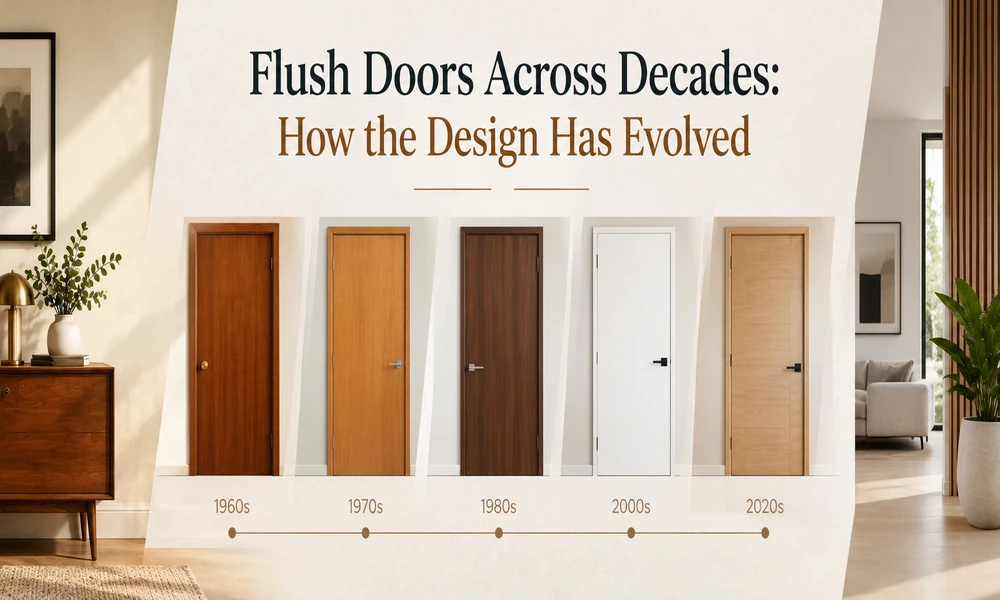
Have you ever thought about how some doors can blend into modern interior design, while others stand out immediately due to their use of decorative panelling, moulding, or detail? The distinction exists for a purpose; it was formed by various developments in architecture, design, manufacturing and the changing approaches designers have had in their use of interior space over the years.
The evolution of the flush door allows us to understand why this door type is used so commonly. High quality Flush doors, which are flat-finished, facilitate the maximum amount of choice in terms of the types of finishes used and visually integrate well because of the flush door’s inherent simplicity.
The Original Movement Towards Simplicity
Traditional panel doors exhibited structural features in the form of panels and frames that could be perceived. Flush doors approached construction in a different way, with their external surfaces displaying only a flat face. As it turns out, this led to a much simpler appearance, permitting the use of engineered wood in the manufacturing process.
For the flush door to become commonplace, the progression and wider application of plywood had a role to play. With multiple layers of veneer glued together to form stable panels, doors could be made out of stable plywood with the continuous where it would otherwise have been impossible to accomplish that level of smoothness.
The Mid-Century Modern Style Has Played a Significant Role in the Increasing Popularity of Flush Doors
As contemporary architecture became more popular, its emphasis on simplicity and functionality continued to increase. Flush doors have a flat surface that integrates well into modernism since they are less visually disruptive and could be used more unobtrusively in decorative layouts.
The factory production process of flush doors also has had an impact on the trend. Engineered construction of doors allowed door manufacturers to produce flush doors with precise dimensions and specifications. According to the supplied Royale Touche document, flush doors are identified as flat-surfaced doors not having the protrusions or cavities known to characterise classical panel doors and are associated with contemporary and minimalist or industrial style interiors.
From a Practical Member of a Room to a Design Element
As interior design developed, the flush door has turned from being just a usable item to an opportunity for a designer. The flush door will either be covered in laminate, veneer, paint, or something decorative in order to coordinate visually with surrounding furniture or flooring.
The potential of enhancing that flexibility makes flush doors widely used in homes, offices, hotels, etc. Designers will either design flush doors so they seem to blend in with the walls or create a noticeable contrast with different colours, textures, and wood-grains.
What the Modern Flush Door Means
Now, a flush door is much more than being flat. The core, veneer, adhesive system and surface treatment all affect its performance. Different aspects such as moisture exposure, dimensional stability, strength, hardware fixing, and finishing needs of each occasion help define the construction to be chosen.
Flush door construction mentioned in the Royale Touche document is based on using dual cores of Southern Yellow Pine with Gurjan face veneer, along with BWP construction, and development of termite and boring system.
The Advancement and Future Development in Flush Door Design
The trend of flush doors continues thanks to the preference for coherence of design principles and formal simplicity. The flush door might either fully merge with the wall by means of matching finish or serve for bright contrast based on the use of visually opposite material.
The above explanation does not imply that doors with panels are out-of-date. Panel doors will thrive in traditional, classic, and transitional designs where visible construction is part of the design.
Flush Doors and the Changing Needs of Modern Interiors
The growing preference for flush doors also reflects the increasing importance of adaptable interior surfaces. Their plain construction provides designers with a neutral base that can be finished according to the character of a space. This makes them suitable for interiors where continuity between doors, walls, furniture and flooring is important. At the same time, advances in engineered wood and manufacturing have allowed flush doors to combine a clean appearance with structural requirements. Their continued use demonstrates how functional construction can also support changing aesthetic preferences.
Conclusion
The evolution of flush doors has close ties with changing priorities in architecture and interior design. Panel doors served to expose their structure through visible mouldings and framework, while flush doors provided that structure behind their plain surface.